PIDSnap

Find out what is actually wrong with that loop

Photograph the trend screen and the faceplate. PIDSnap reads them, tells you whether the problem is tuning or something tuning cannot fix, and — if it is tuning — walks you through it one observed change at a time.

Run a free check Start from a symptom

Step 1: your loop is misbehaving A trend showing an under-damped process variable oscillating around setpoint through several peaks without settling. 1 Your loop is misbehaving Hunting, overshooting, never settling Four peaks and still going PVSP
Your loop is misbehaving. PV is hunting and the output is driving it.
Step 2: photograph the trend and the faceplate The same misbehaving trend, captured by photographing the operator screen. 2 Snap the trend The screen and the faceplate, as they are A photo of the screen is enough PVSP
A photo from your phone. No connection needed.
Step 3: PIDSnap classifies the problem The oscillating trend, diagnosed as aggressive tuning with the gain too high for the loop's dead time. 3 PIDSnap says what it is Named, and whether tuning can fix it Aggressive tuning: gain too high PVSP
PIDSnap tells you what it is — and whether tuning can actually fix it.
Step 4: one change at a time, with the value to type The previous oscillating response shown faintly behind the new damped response, with the exact gain change that produced it. 4 One change at a time The value to type, in your own units Take the gain from 0.40 to 0.28 the faint trace is where it was before PVSP
Reduce the gain, re-snap, confirm it worked.

Run a free check Start from a symptom

And when tuning is not the answer

Valve stiction: a limit cycle tuning cannot remove A trend in which the controller output ramps smoothly while the process variable moves in abrupt steps past where it was asked to go, producing a cycle of constant amplitude that does not decay. MECHANICAL — NOT TUNING Valve stiction The output ramps. The PV jumps. PVOP The cycle holds its amplitude instead ofdecaying — that is what separates stictionfrom a loop that is merely over-tuned. Put the loop in manual and it stops.
Valve stiction — the controller output ramps smoothly while the process variable moves in abrupt steps. Put the loop in manual and the cycle stops. No tuning session is worth buying until the valve is fixed.

What it reads

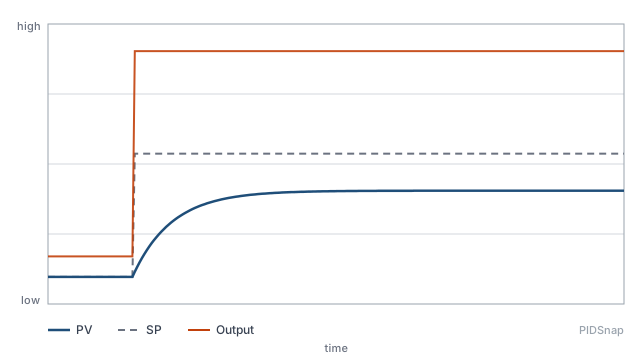
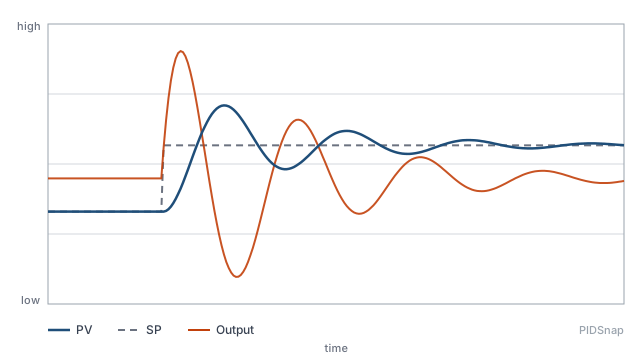
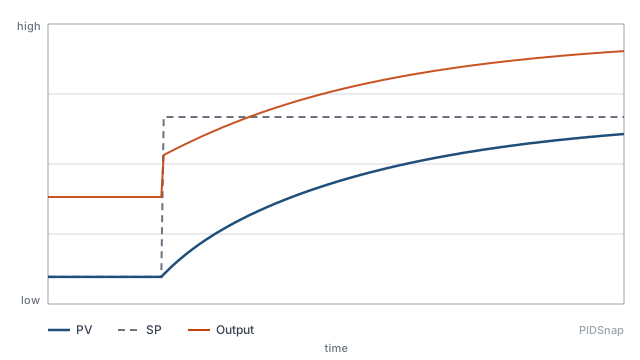
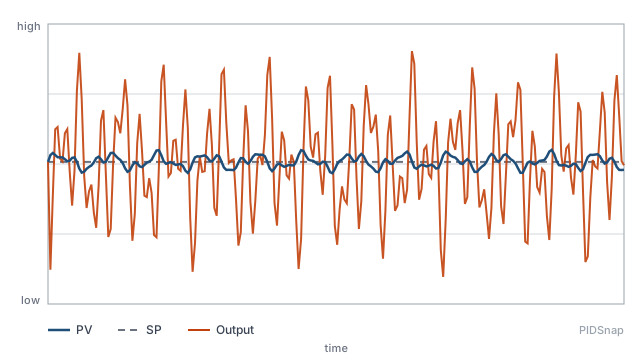
Every trend PIDSnap receives is classified against eight fundamental loop signatures.
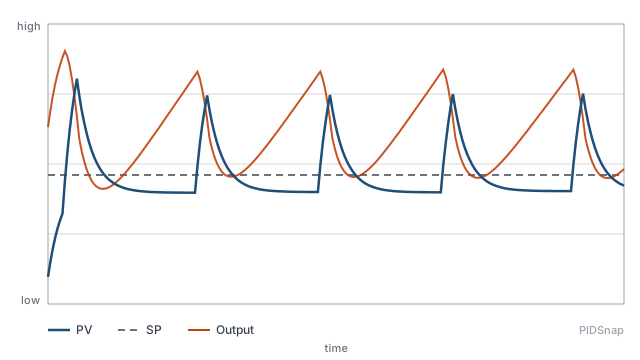
Valve stiction trend signature Valve stiction
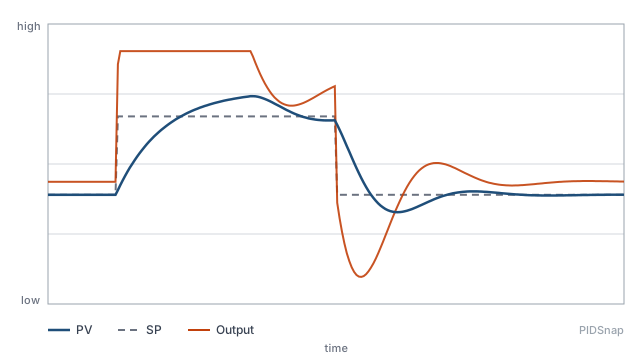
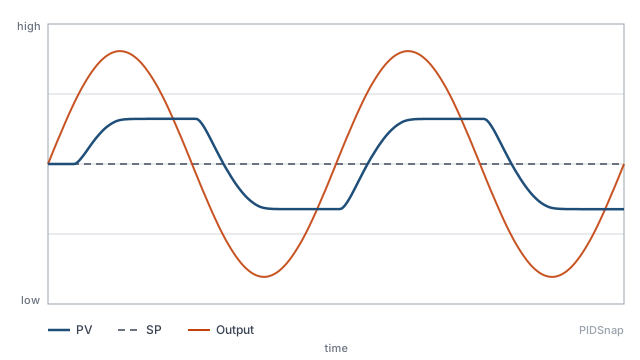
Output saturation trend signature Output saturation
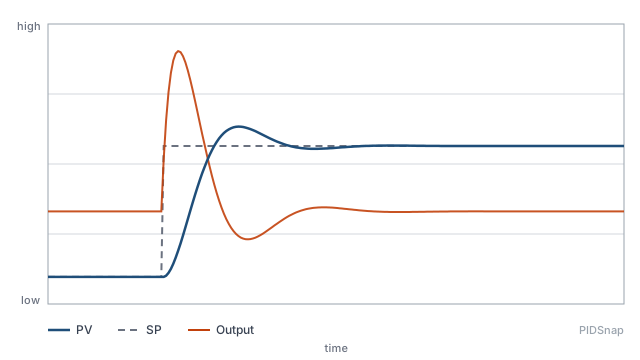
Aggressive tuning trend signature Aggressive tuning
Sluggish tuning trend signature Sluggish tuning
Noise amplification trend signature Noise amplification
Integral windup trend signature Integral windup
Mechanical backlash trend signature Mechanical backlash
Healthy response trend signature Healthy response

How it works — end to end

The guided tuning cycle: snap, diagnose, change, verify, repeat A four-stage loop stacked vertically. Snap the trend and faceplate; PIDSnap diagnoses the shape; it issues one change with an explicit value; you verify by snapping again. The cycle repeats until the response settles with one small overshoot, or until PIDSnap concludes tuning is not the answer. The guided cycle Four moves, repeated until it settles 1 Snap One photo of the trend, one of the faceplate. 2 Diagnose PIDSnap names the shape and says if tuning can fix it. 3 Change One value, in your units, with what ends the step. 4 Verify Snap it again. Better or not, the answer drives the next move. Repeat until it settles — or until PIDSnap says tuning is not the answer Stop at one small overshoot, then flat

What it does

Pre-flight check

Sixteen deterministic checks against the loop's configuration, run before you touch anything. Derivative on a fast loop, reset faster than the dead time, a valve running wide open — the things no test will fix. Free, unlimited.

Trend diagnosis

Upload a photo of the trend. PIDSnap classifies the shape — stiction, windup, saturation, noise amplification, aggressive tuning — and says plainly when the answer is mechanical and no tuning session is worth buying.

Guided tuning

One change at a time, phrased in your controller's own units and direction, with the value to type. Every step has an observation that ends it and an abort criterion. If it stops converging, you get a diagnosis of what is limiting the loop instead.

Common starting points

Control valve hunting

A hunting control valve is usually mechanical, not badly tuned. How to tell stiction, oversizing and aggressive tuning apart from the trend, and what to check first.

PID loop oscillating

An oscillating PID loop tells you what is wrong through the shape and period of the cycle. How to read decaying, growing and constant-amplitude oscillation.

Valve stiction symptoms

Stiction produces a distinctive limit cycle: stepped PV against a smoothly ramping output, constant amplitude, gone in manual. How to confirm it.

Sluggish control loop

A slow loop is not always under-tuned. Measurement filtering, drive ramps and output limits all produce sluggishness that tuning cannot fix.

Run a free PIDSnap check on this loop

Two photos, thirty seconds, no signup. The pre-flight check finds the structural problems that no amount of tuning will fix — before you touch the controller.

Start a free check